Facts and myths about silencing heat pumps and air conditioners: What works and what is a waste of money?
Heat pumps and air conditioners are becoming standard in modern construction. We value them for their efficiency and environmental friendliness, but their growing popularity has also revealed their biggest drawback – noise. The annoying hum of a fan can effectively ruin relations with neighbours and even cause officials to intervene.
In response to this problem, the internet is flooded with a wave of “proven” ways to silence these devices. Unfortunately, many of them are myths that, at best, will have no effect and, at worst, can damage expensive equipment. In this article, we will separate fact from myth and explain which solutions are truly effective.
MYTHS: Popular but ineffective methods of silencing heat pumps
A wooden cover, an anti-vibration mat, or perhaps a dense hedge? Many popular “solutions” to heat pump noise are myths. Let’s analyse three common myths.
Myth 1: “A simple wooden or metal cover is enough.”
An aesthetic wooden pergola or a simple “shed” from a DIY store may hide the device from view, but not from noise. Such structures have no sound insulation properties. What is more, a rigid sheet metal enclosure can act as a resonance box, amplifying humming and vibrations instead of dampening them. In addition, if such enclosures are poorly designed, they can disrupt airflow, leading to pump overheating, reduced efficiency, and even loss of the manufacturer’s warranty.
Myth 2: “An anti-vibration mat will do the trick.“
This is a popular but often misunderstood myth. An anti-vibration mat is a very important element because it effectively reduces vibrations transmitted from the device to the ground (so-called material noise). However, it should be remembered that this is only part of the solution. The main source of heat pump noise remains the fan, which emits airborne noise that the mat has no effect on. Therefore, using it on its own will improve the situation but will not solve the problem.
Myth 3: “I’ll plant some thuja trees, it’ll be quieter.“
A dense hedge is a great way to visually shield a heat pump, but its acoustic properties are negligible. Vegetation is only able to disperse high-frequency sounds to a small extent. Unfortunately, it is virtually helpless against the low-frequency hum that is most annoying in the operation of heat pumps.
“I definitely recommend Silencions. The enclosure was custom-made and installed a year ago. Everything went according to plan. The enclosure fits perfectly and looks aesthetically pleasing. It also protects the pump. My neighbour has stopped complaining about the noise. I had no problems with the installation instructions. The components are solidly made and remain in the same condition after a year of use. Contact with the company at every stage of the order was exemplary. I have not noticed any increase in the operating costs of the pump.”
FACTS: What really works? Professional acoustic enclosure for heat pumps
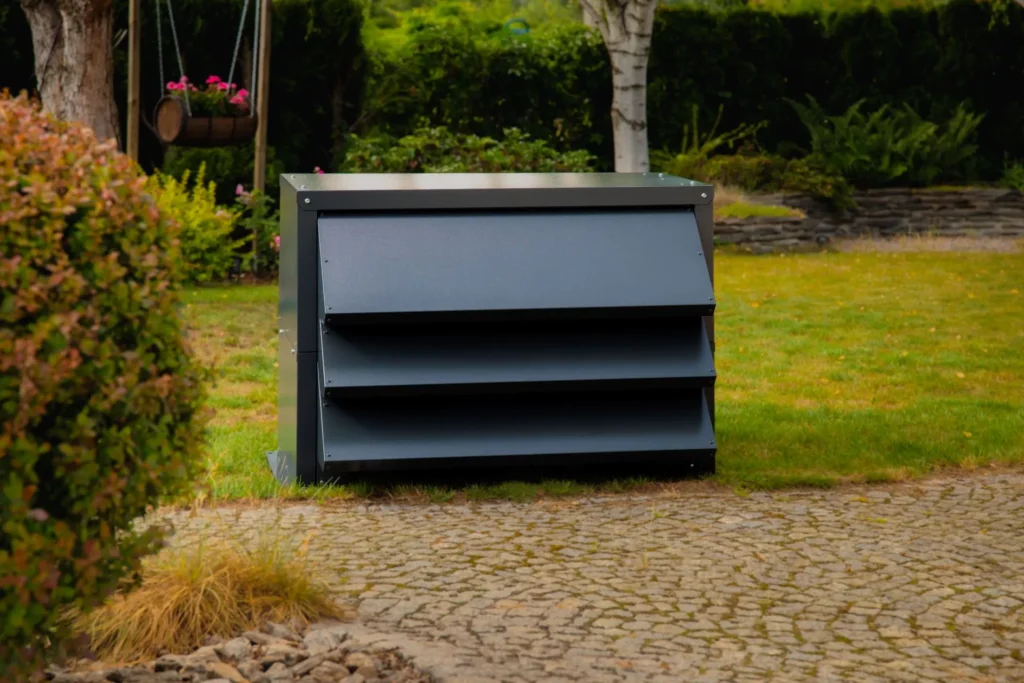
Effective silencing of a heat pump or air conditioner is based on engineering and the laws of physics. For an already installed device where the main source of noise is the fan, the most effective solution is a professional acoustic enclosure.For an already installed unit where the main source of noise is the fan, the most effective solution is an acoustic enclosure, a solution developed by acoustics specialists.
Fact 1: The key is a design that allows air to flow freely.
Unlike amateur covers, our engineer-designed enclosures do not interfere with the operation of the device. The key element here is special acoustic drip caps. Their placement and fixed angle of inclination (45 degrees) are designed to fulfil two functions simultaneously:
To reduce noise – both through their design and through a sound-absorbing acoustic insert.
Effectively change the direction of air flow without affecting its intensity, which guarantees full device performance.
As a result, our design minimises noise without interfering with the operation of the device, which is crucial for its full performance and service life.
Fact 2: Effectiveness must be measurable and verified.
We often do not realise that the law precisely defines the permissible noise levels that can penetrate neighbouring properties. For example, Polish law precisely defines the permissible noise levels that can penetrate neighbouring properties, and these values vary depending on the type of development.
Many heat pumps can easily exceed these levels, becoming a source of conflict with neighbours. Professional solutions offer a specific noise reduction, measured in laboratory conditions and expressed in decibels (dB). This is hard data that guarantees results – unlike ‘home remedies’. A high-quality heat pump enclosure should have a technical data sheet confirming its effectiveness.
Fact 3: The noise of any heat pump or air conditioner can be reduced.
Non-standard installation locations are a common challenge – a heat pump on a narrow balcony, under a bedroom window or on uneven ground. In such situations, universal, ready-made covers often fail.
The fact is that an effective solution must be perfectly suited to such conditions. Therefore, the key is the ability to customise the heat pump enclosure, i.e. to create a structure that is fully adapted to the dimensions of the device and the specifics of the environment. This is the only way to reconcile high acoustic efficiency with aesthetics and the requirements of difficult installation.
Are you just planning to purchase and install a heat pump? It is worth thinking about acoustics from the very beginning.
Air conditioner noise? Proven solutions for outdoor units
Exactly the same principles and solutions apply to the silencing of outdoor air conditioning units. They also generate airborne noise and vibrations, and their efficiency depends on the free flow of air. Therefore, an acoustic enclosure for the air conditioner is also the best solution for silencing them. It has been designed in accordance with the principles of acoustics, and its effectiveness has been confirmed by tests and measurements.
Summary: how to effectively silence a heat pump?
Silencing a heat pump is not a place for experimentation. Popular, makeshift methods risk not only wasting money, but also potentially damaging expensive equipment. An effective solution to the noise problem is based on engineering and an understanding of the laws of physics.
Choosing a tested, effective acoustic enclosure allows you to really solve the problem, not just mask it. It is the best way to protect the device, take care of the aesthetics of the surroundings, regain peace and quiet, and maintain good relations with your neighbours.
Would you like to reduce the noise of your heat pump or air conditioner?
Noisy noise is not only a source of frustration and neighbourly conflicts. It also poses a risk of exceeding standards (up to 40 dB at night) and wasted money on makeshift solutions that can interfere with the operation of expensive equipment.
Contact us! Our specialists will analyse your problem and help you choose an effective, tested acoustic enclosure that will ensure your peace of mind and good relations with your neighbours.
We are available on working days from 7:00 a.m. to 5:00 p.m.