


A partition wall is not just a way to divide space — it is, above all, a fire barrier and acoustic protection. However, the need to run installations through partitions creates a serious engineering challenge: every opening is a critical point that, on one hand, increases the risk of fire propagation and, on the other, reduces the wall’s acoustic insulation.
In the following Case Study, we analyze the implementation of a solution for a company in the construction industry: a manufacturer of cable penetrations. Our task was to develop a technology that would not only increase noise attenuation, but above all ensure full penetration functionality — including the ability to reconfigure cables without limitation — within a spatial constraint of 50 mm in depth.
Key Project Data:
- Client: a supplier of specialized solutions for securing cable penetrations in walls (construction industry).
- Challenge: providing an effective sound barrier in a penetration that must allow easy cable reorganization and future servicing.
- Key constraint: the element thickness may not exceed 50 mm.
- Result: noise reduction of over 15 dB in critical frequency bands while maintaining full penetration functionality (ability to modify cable layout). Acoustically, the effect of a solid wall was achieved — as if the mounting opening did not exist at all.

Client:
a supplier of specialized solutions for securing installation penetrations (construction industry).

Challenge:
providing effective acoustic insulation in a penetration, while maintaining freedom of servicing and reconfiguration of installations.
Key constraint:
the element thickness may not exceed 50 mm.
Result:
noise reduction of over 15 dB in critical frequency bands while maintaining full penetration functionality.
Construction and Acoustics: The Problem of Airtightness in Cable Penetrations
The challenge facing the construction industry stems from a fundamental conflict: how to maintain the highest fire resistance of a partition while ensuring full functionality and flexibility for running technical installations?
Both in our client’s specialized products and in general construction, cable penetrations are critical points. Every opening in a partition (wall), necessary for running cables, creates a risk of fire transmission and reduces the wall’s acoustic insulation.
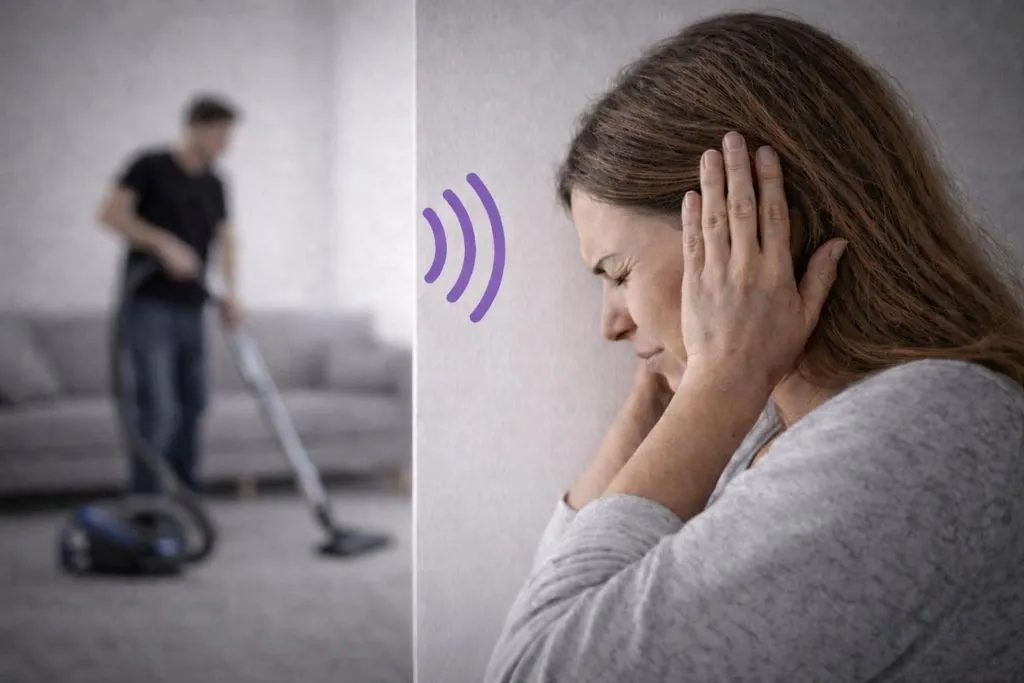
The consequences for the acoustics of apartments and rooms in such applications are direct and severe. Sound passes through the opening with minimal attenuation, leading to:
- increased noise levels in adjacent rooms,
- degradation of working comfort or occupant experience,
- loss of the entire partition’s acoustic properties — even if the wall itself meets high insulation requirements, it loses those properties if an acoustically leaky penetration is built into its structure.
The Client’s Challenge: Noise Reduction While Maintaining Easy Service Access to Installations
Our client operates in the construction industry and specializes in providing specialized solutions for securing and sealing installation penetrations in walls. Such penetrations are essential for routing installations between rooms via the shortest possible path.
The market standard for sealing such passages is permanently flexible sealant compounds. While effective at blocking fire spread and improving sound attenuation, they come with certain functional limitations that the client wanted to eliminate in their new product:
- They are a “one-time” solution: once cured, the compound makes it difficult or even impossible to quickly modify the installation without partially destroying the seal.
- They require precise application: errors during application lead to leaks.
- They can lose flexibility over time: especially in locations exposed to micro-movements of the partition or temperature fluctuations, which is standard in construction.
- They block service access: they are not suitable where the penetration must remain accessible for modifying cable configurations.
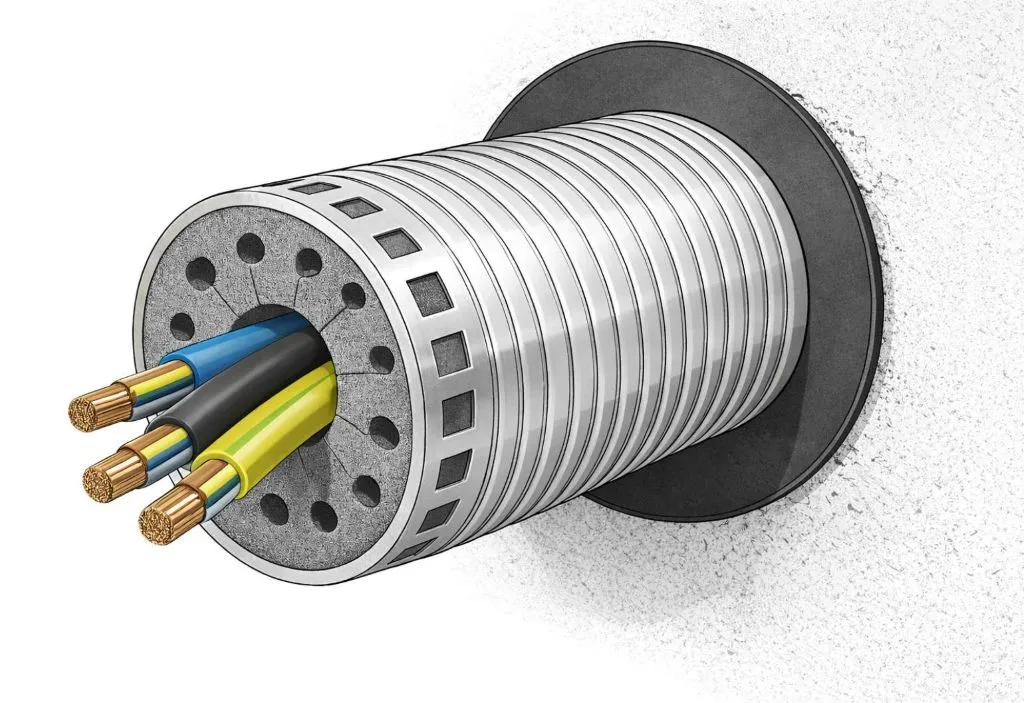
Our client was looking for a solution that would increase the acoustic insulation of the cable penetration (limit noise transmission between rooms), while also allowing the penetration to be opened and easily modified (e.g., during installation servicing or when cables need to be replaced).
They began developing a new product: a reconfigurable cable penetration that can be opened during cable installation and then closed, maintaining the required fire resistance.
The challenge also became developing a solution that would increase sound attenuation in an open penetration without exceeding the maximum thickness of 50 mm and without limiting the throughput or functionality of the module.
This constraint ruled out typical methods used in acoustics:
- conventional absorptive silencers are characterized by large volume and mass,
- standard porous materials (foams, mineral wool) with low surface mass and limited thickness do not provide sufficient effectiveness.
What was needed was a solution based not on mass, but on precisely engineered geometry, capable of generating additional attenuation in an open structure.
The Process and Solution: From Diagnosis to Implementation
To effectively solve the problem of reduced acoustic insulation in the cable penetration, we carried out a complete research process, including laboratory diagnostics, preparation of a geometric silencer model, and numerical and experimental validation.
Step 1: Problem Diagnosis and Laboratory Measurements
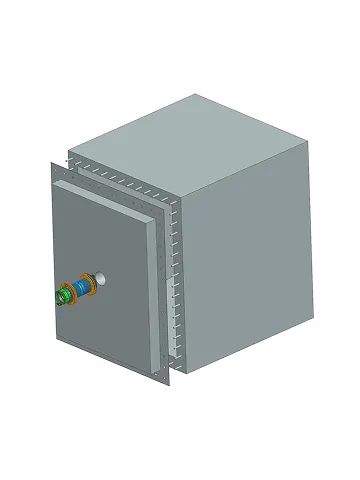
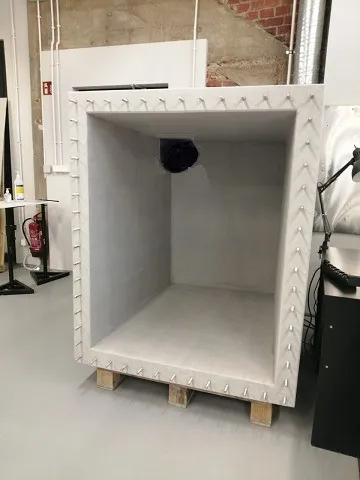
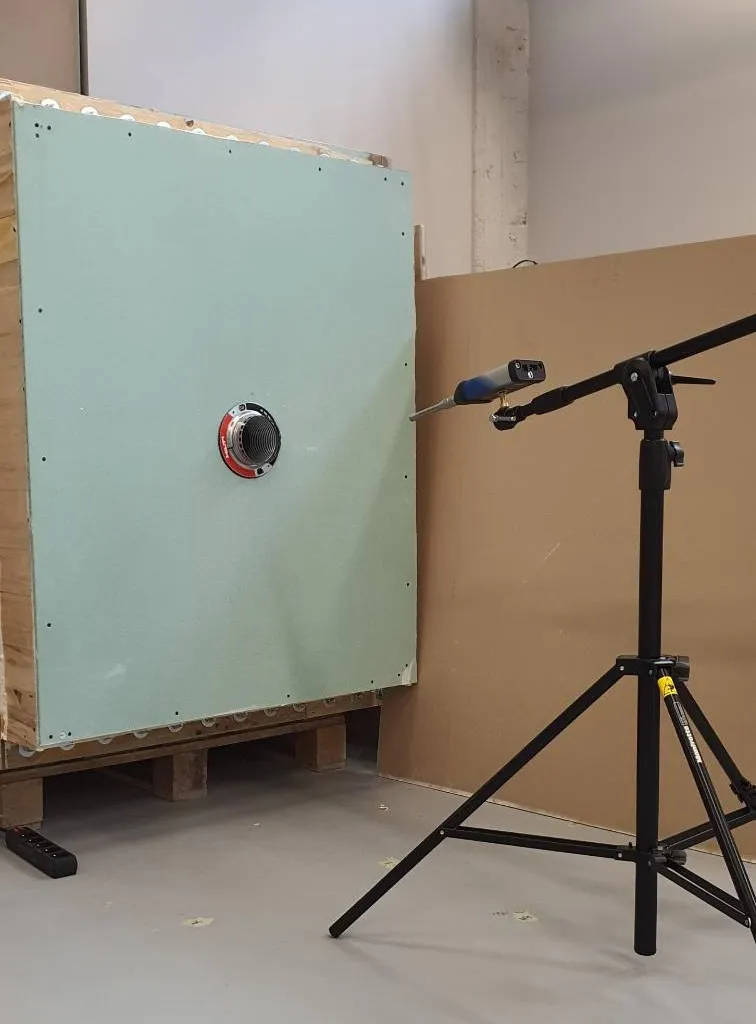
After receiving the penetration model from the client and defining the guidelines, we proceeded to acoustic measurements. The tests were conducted on a laboratory stand for measuring acoustic insulation and insertion loss in a diffuse field. This is the most demanding test environment for partitions, due to the fact that acoustic waves strike the partition from any angle (Fig. 1).
In the first stage, we performed a series of transmission loss and insertion loss measurements for three scenarios:
- Full wall (reference point),
- Wall with a cut-out opening,
- Wall with the installed reconfigurable cable penetration.
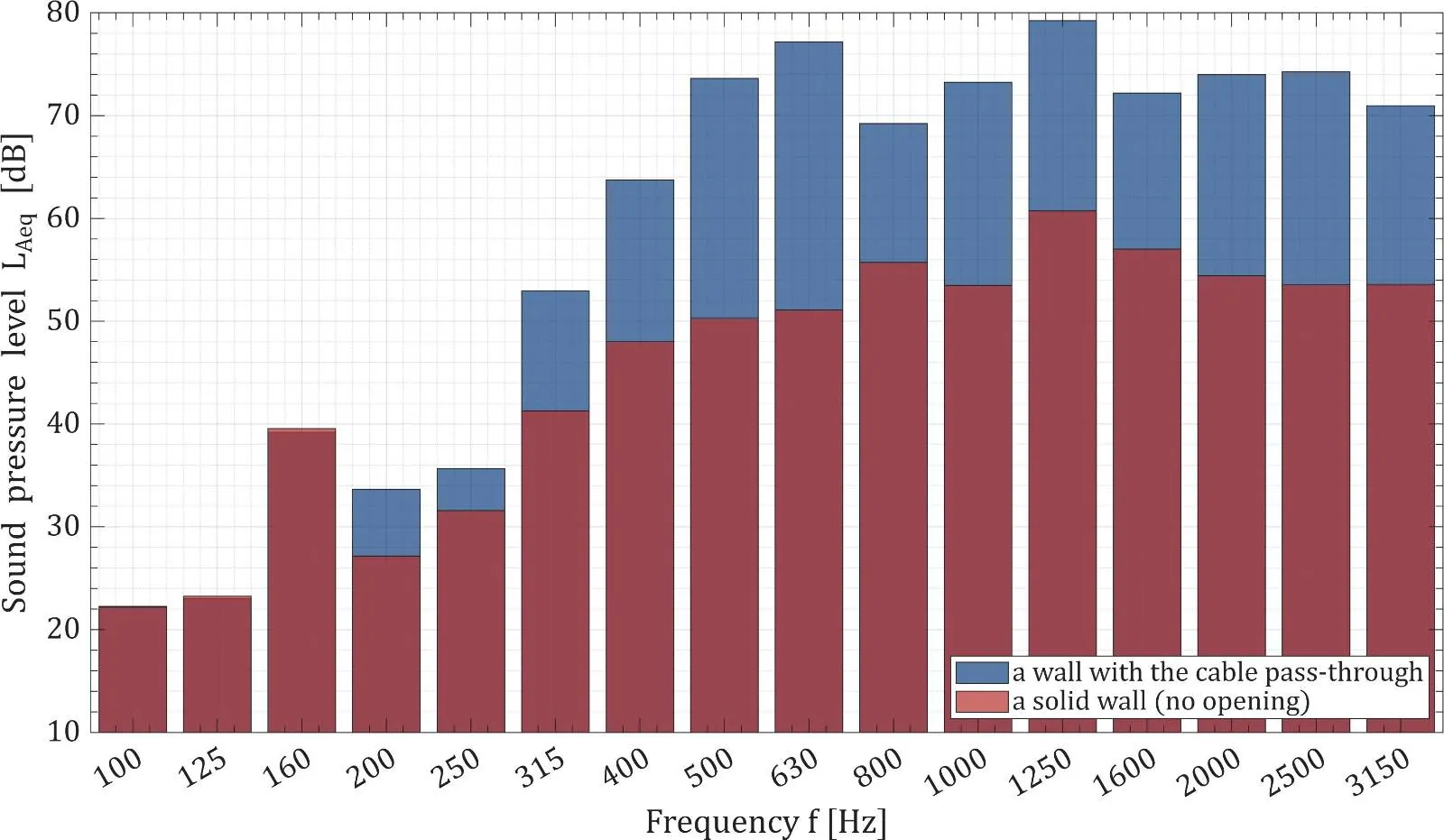
Analysis conclusions: the analysis of results revealed a broadband drop in acoustic insulation after adding the opening and the penetration. The greatest reduction in insulation parameters was observed in the 1000 Hz and 1250 Hz one-third octave bands (Fig. 2). This frequency range became the primary focus of our work.
Step 2: Technology Selection — Geometry Instead of Mass
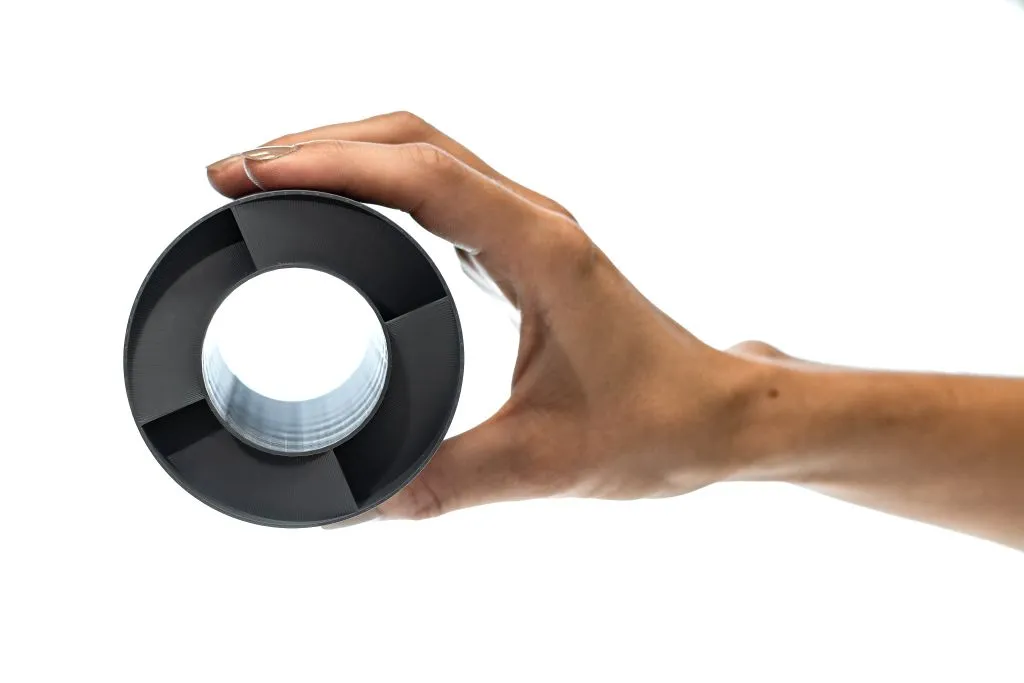
Based on the measurement analysis, we developed a numerical model of the s|TWIST| silencer and selected its geometric parameters for the specific frequency bands.
Limiting the silencer length to just 49 mm, while maintaining an open structure, ultimately ruled out conventional sound-absorbing solutions. Their effectiveness at such a small thickness would be insufficient, as it depends mainly on surface mass and airflow resistance rather than geometry.
The use of the s|TWIST| acoustic silencer instead made it possible to achieve high attenuation through controlled internal geometry, without increasing mass or thickness.
Step 3: Implementation and Validation
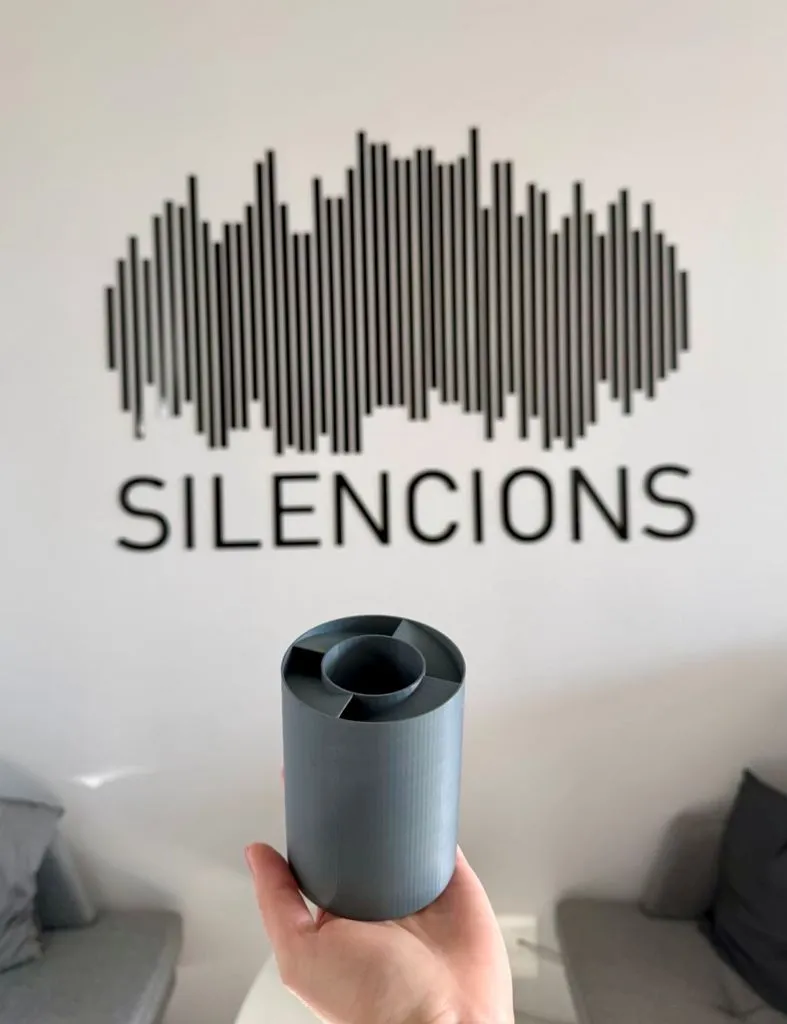
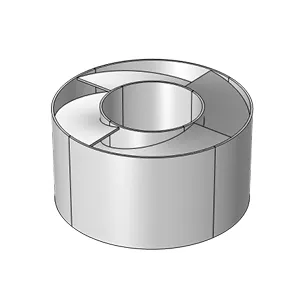
After selecting the appropriate model dimensions, we produced a silencer prototype using 3D printing (geometry concept shown in Fig. 3). We then performed an insertion loss (IL) measurement for the penetration with and without the silencer, to verify effectiveness under real-world conditions.
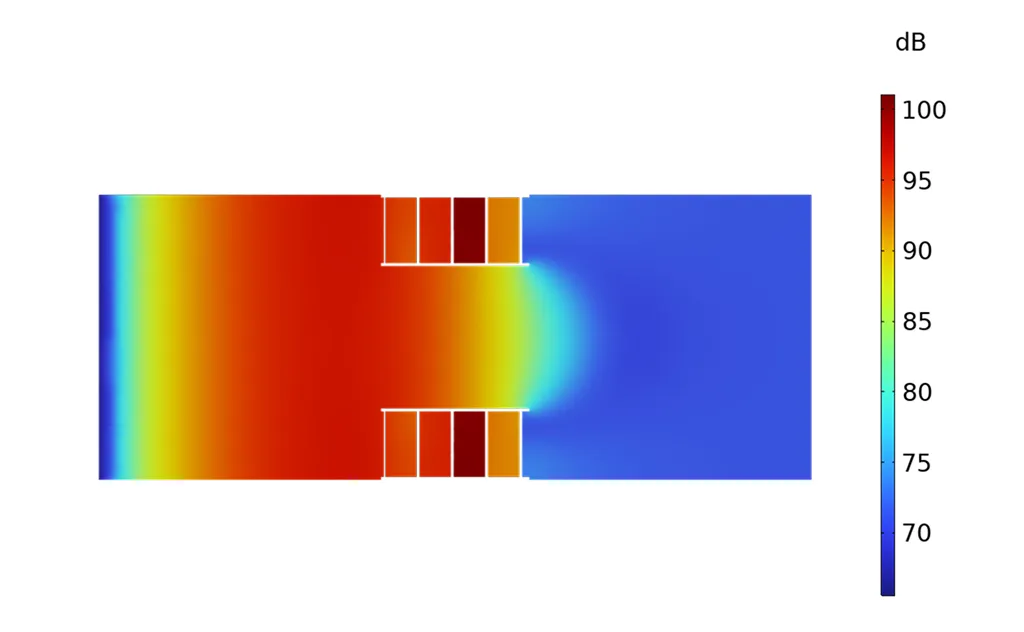
A sample distribution of acoustic pressure levels obtained in numerical simulations upstream and downstream of the silencer at 1000 Hz is shown in Fig. 4.
Measurable Results: Over 15 dB Reduction — Acoustic Insulation with a Cable Penetration Matching a Solid Wall
The effectiveness of the s|TWIST| solution in such a compact form proved to be breakthrough for the client’s project. Experimental measurements and numerical simulations unambiguously confirmed the achievement of the objectives:
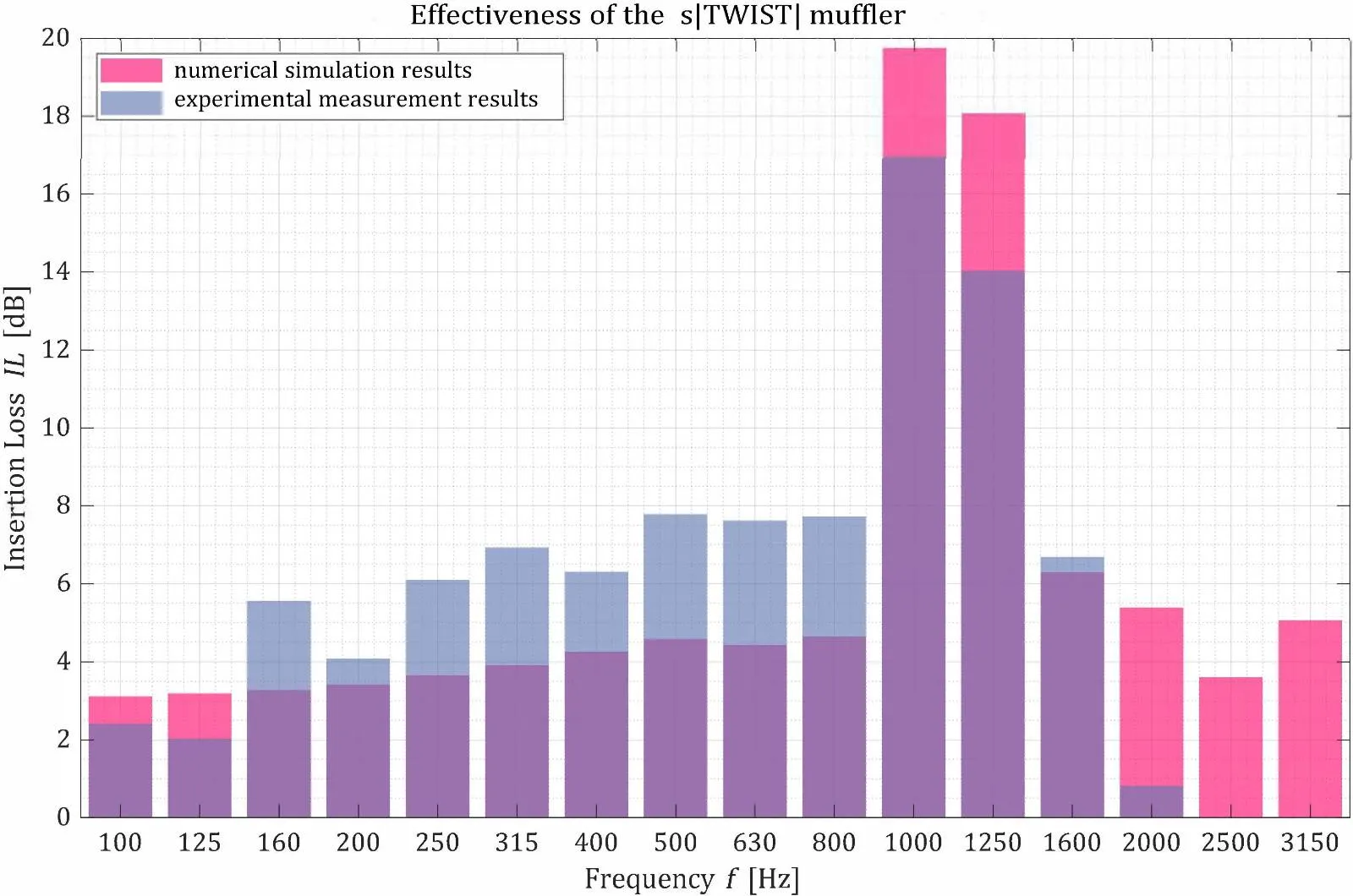
- Noise attenuation increase of approx. 15 dB: in the one-third octave bands identified as problematic (1000 Hz and 1250 Hz), the silencer provided a reduction in sound level transmitted through the opening of 15 dB (Fig. 5).
- Restoration of partition insulation to solid-wall level: the achieved attenuation completely offset the insulation losses. In practice, this means restoring the partition’s insulation to the level of a solid wall (without openings).
- Preserved functionality and reconfigurability of the penetration: this result was achieved with an element length of only 49 mm, with no negative impact on the ability to modify cables.
- Possibility of scaling the s|TWIST| geometry to other frequency ranges — including below 1000 Hz.
Translating the results into practice:
The use of the s|TWIST| acoustic silencer allowed the client to bring to market a product that maintains the required fire resistance class, ensures full reorganization capability and service access, and most importantly — reduces sound levels to values close to those of a solid wall, thereby ensuring full user comfort and eliminating the spread of intrusive noise.
Key Conclusions: Acoustic Silencer Geometry as a New Standard in Partition Acoustic Tightness
The client from the construction industry faced a dilemma: how to ensure full service accessibility and the ability to reconfigure installations, without losing the acoustic insulation of the partition.
This Case Study proves that even under extreme dimensional constraints (below 50 mm), precisely selected s|TWIST| silencer geometry can replace a thick layer of insulation materials.
Most importantly, however: this solution is scalable — the s|TWIST| geometry can be adapted to attenuate other frequency ranges as well, depending on the specifics of a given installation.
The achieved result — acoustic insulation of a structure with a cable penetration and s|TWIST| silencer matching a solid wall — eliminates the risk of neighbor complaints, ensures compliance with standards, and enhances the product’s usability, thereby ensuring full compliance with the required fire (EI) and acoustic classes.
Turn an Acoustic Problem into a Market Advantage — Contact Us!
If you operate in the construction industry, have your own product (e.g., a fan, air handling unit, or penetration) or face a dilemma where functional requirements conflict with the need for acoustic insulation, contact us!
Our acoustics engineers will identify and diagnose the source of any acoustic challenge and then — based on data — design and deliver the most effective solution.
We are available on business days from 7:00 AM to 5:00 PM.